Introduction
These 10 rubber plant care tips will keep your rubber plant glossy, upright and growing strong, even in a small apartment. With big, leathery leaves that shine like polished leather, it is one of the most rewarding houseplants you can own, and it asks for very little in return.
The rubber plant is having a moment. Designers are choosing it as the new statement plant for living rooms and small spaces. It grows into a tall, handsome tree, tolerates the odd missed watering, and suits almost any style of room. These 10 rubber plant care tips are built around one idea: give it steady, simple care and it will reward you for years.
In this guide, these 10 rubber plant care tips show you how to water, feed and place your plant, how to keep its leaves clean and glossy, and how to prune and repot it without stress. Follow these 10 rubber plant care tips and your plant will stay full, green and beautiful.
Table of Contents
What Makes the Rubber Plant Special
The plant sold as a rubber plant is Ficus elastica, a fig tree native to Southeast Asia. Outdoors in a warm climate it grows into a huge tree, but indoors it grows slowly and stays a manageable size for years — a natural fit for apartments and small homes.
Its leaves are the star of the show. Each one is thick, oval and deeply glossy, and new leaves unfurl from a pinkish sheath at the tip of each stem. The classic form has deep green leaves, but there are also burgundy forms with near-black foliage and variegated forms with cream and pink edges. All of them follow the same 10 rubber plant care tips in this guide.
Rubber plants were once grown for the milky sap in their stems, which can be made into rubber. Today they are grown purely for their looks, and they have become the go-to statement plant for people who want the drama of a fiddle leaf fig without the fussiness. If you already enjoy monstera care, you will find the rubber plant an easy companion — both like bright light and a steady routine.
One thing to know before you bring one home: the sap can irritate skin and stomachs, so wear gloves when you prune and keep the plant where curious pets and small children cannot chew the leaves. With that one caution handled, the rubber plant is one of the most forgiving statement plants you can grow, and the 10 rubber plant care tips below keep it that way.
10 Rubber Plant Care Tips
These 10 rubber plant care tips cover light, water, temperature, feeding, pruning and repotting, and they work for every rubber plant sold as a houseplant, green or variegated. Take them one at a time.
Tip 1: Give It Bright, Indirect Light
Rubber plants grow best in bright, indirect light, so an east-facing window is ideal. A south- or west-facing window works too, as long as strong midday sun is softened by a sheer curtain. A little gentle morning sun is fine, but harsh direct sun can scorch the big leaves.
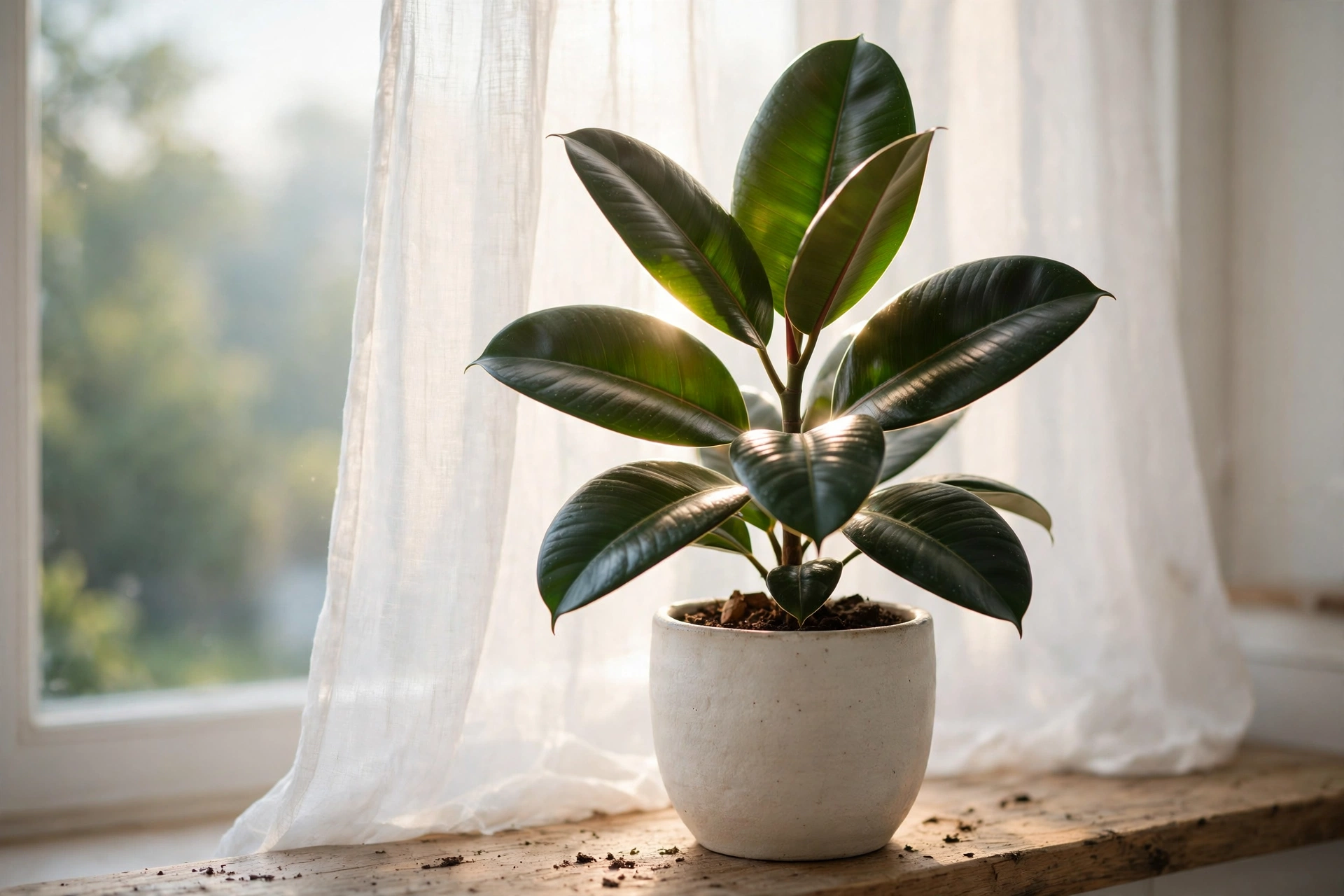
If your plant stretches tall with wide gaps between its leaves, the light is too weak — move it closer to the window. Of all the 10 rubber plant care tips in this guide, this one shapes the plant most: good light means compact growth and rich colour.
Variegated rubber plants need even more light than green ones, because their cream and pink patches hold no chlorophyll — one of the few exceptions in the 10 rubber plant care tips, where the rule is simply more light. In dim light they slowly turn back to plain green. Keep a variegated plant in the brightest spot you have, just out of direct sun, and the colours will stay vivid.
Tip 2: Water Only When the Top Soil Dries Out
Watering is where most rubber plant owners go wrong, so this is one of the most important of the 10 rubber plant care tips. This plant likes its soil to dry out a little between waterings. Push your finger two inches into the soil: if it feels dry, water thoroughly until a little drains out, then empty the saucer.
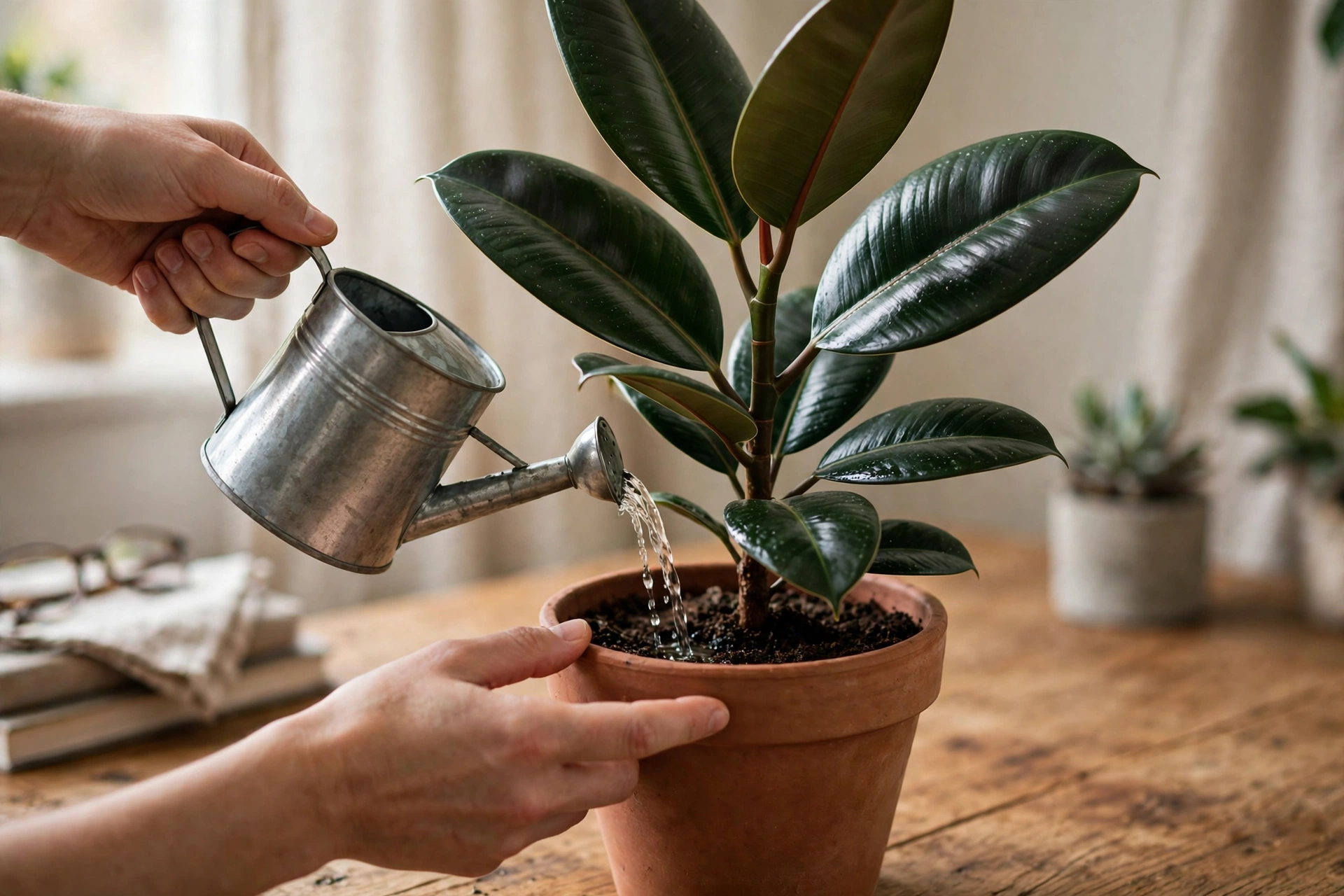
In winter your plant needs far less water, sometimes only once every two or three weeks, because growth slows and the soil stays damp longer. Your winter watering routine should be lighter, and the finger test beats any fixed schedule. Overwatering is the fastest way to lose a rubber plant.
Room-temperature water is a small detail of the 10 rubber plant care tips that is easy to overlook. If your tap water is very hard, let it sit out overnight, because mineral salts build up in the soil over time and show up as brown leaf edges.
Tip 3: Keep It Warm and Steady
Rubber plants like warm, steady rooms, roughly 60 to 80 degrees Fahrenheit, and they dislike sudden changes. Keep yours away from cold draughts, open windows in winter and blasts of air conditioning — a plant in a cold draught can drop leaves overnight.
Never let the temperature fall below about 50 degrees Fahrenheit. A plant left outside on a cold night or beside a draughty door will suffer, and damaged leaves do not recover. Keeping the temperature steady is one of the simplest of the 10 rubber plant care tips, and it matters more than hitting an exact number.
Tip 4: Wipe the Leaves Clean
Those big, glossy leaves collect dust, and dusty leaves cannot photosynthesise well. Wipe each leaf with a soft, damp cloth once a month, supporting it from underneath so it does not snap. This is one of the simplest of the 10 rubber plant care tips, and it makes the biggest visible difference: clean leaves shine.
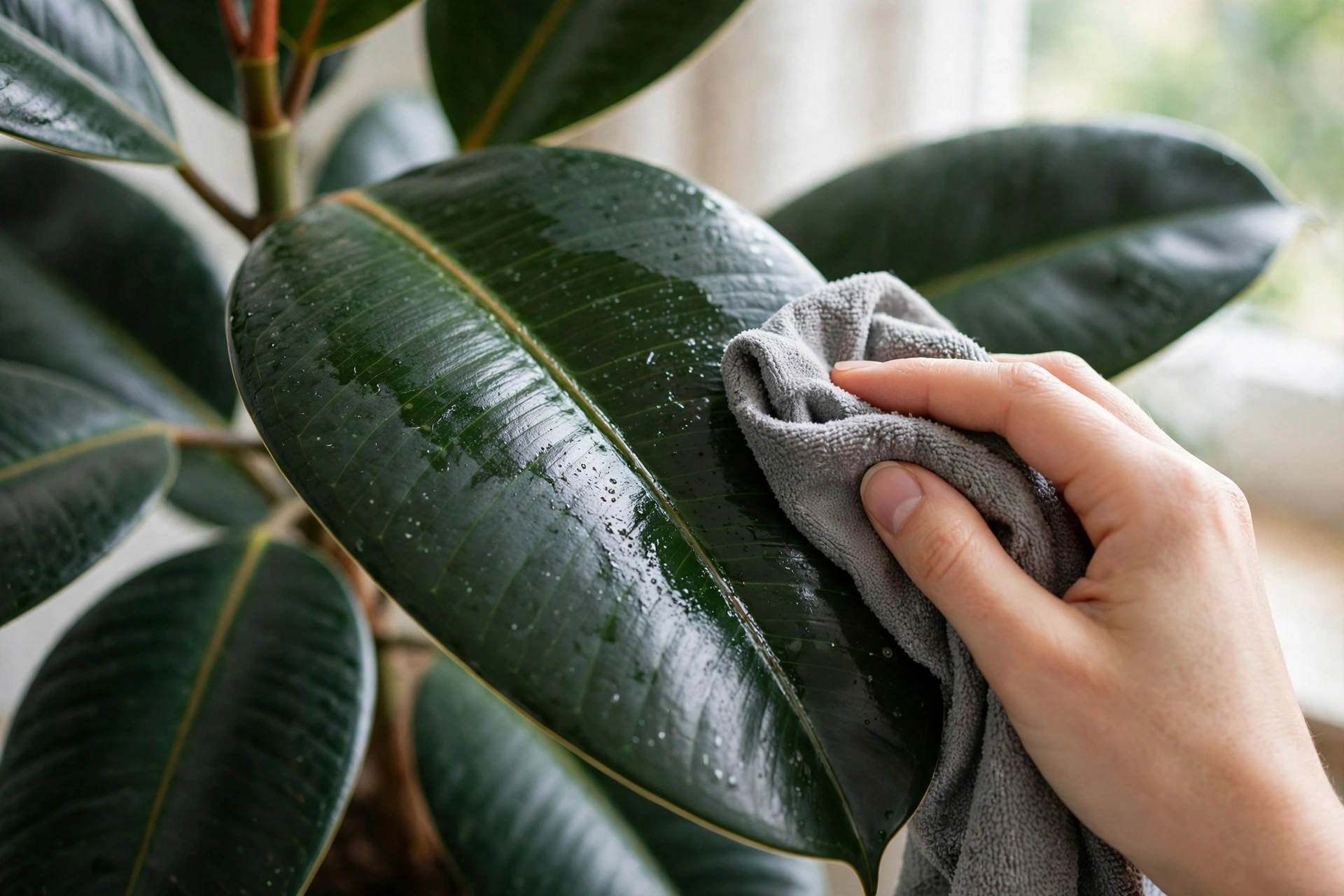
Skip leaf-shine sprays, which can clog the tiny pores on the leaf surface — plain water on a cloth is all you need. While you wipe, check the undersides for pests: it is the easiest inspection you will ever do, and catching a problem early saves the plant.
Tip 5: Feed Lightly in Spring and Summer
Rubber plants are not heavy feeders, and feeding is a small part of the 10 rubber plant care tips. Give yours half-strength balanced liquid fertiliser once a month from spring through summer, while it is actively growing. Always water the soil first, then feed, so the fertiliser never hits dry roots.
Do not feed in autumn and winter, when growth slows — extra fertiliser sits unused in the soil and can burn the roots. If your plant puts out new leaves each month in summer, your feeding is about right.
Tip 6: Prune to Shape and Encourage Branching
Left alone, a rubber plant grows as a single tall stem, which is fine if you want a tree. For a bushier plant, prune the top in spring, cutting just above a leaf node — new branches will sprout below the cut.
Wear gloves when you prune, because the milky sap can irritate skin, and dab the cut with a damp cloth to stop it dripping. You can root the piece you cut off in water or moist soil for a free second plant. Pruning is the most hands-on of the 10 rubber plant care tips, and the most satisfying, because you shape the plant yourself.
Tip 7: Repot Every Two or Three Years
Rubber plants like to be slightly snug in their pots, so repot only every two or three years, in spring, and only one pot size up. Signs it is time: roots circling the drainage holes, water running straight through, or growth stalling even though light and feeding are right.
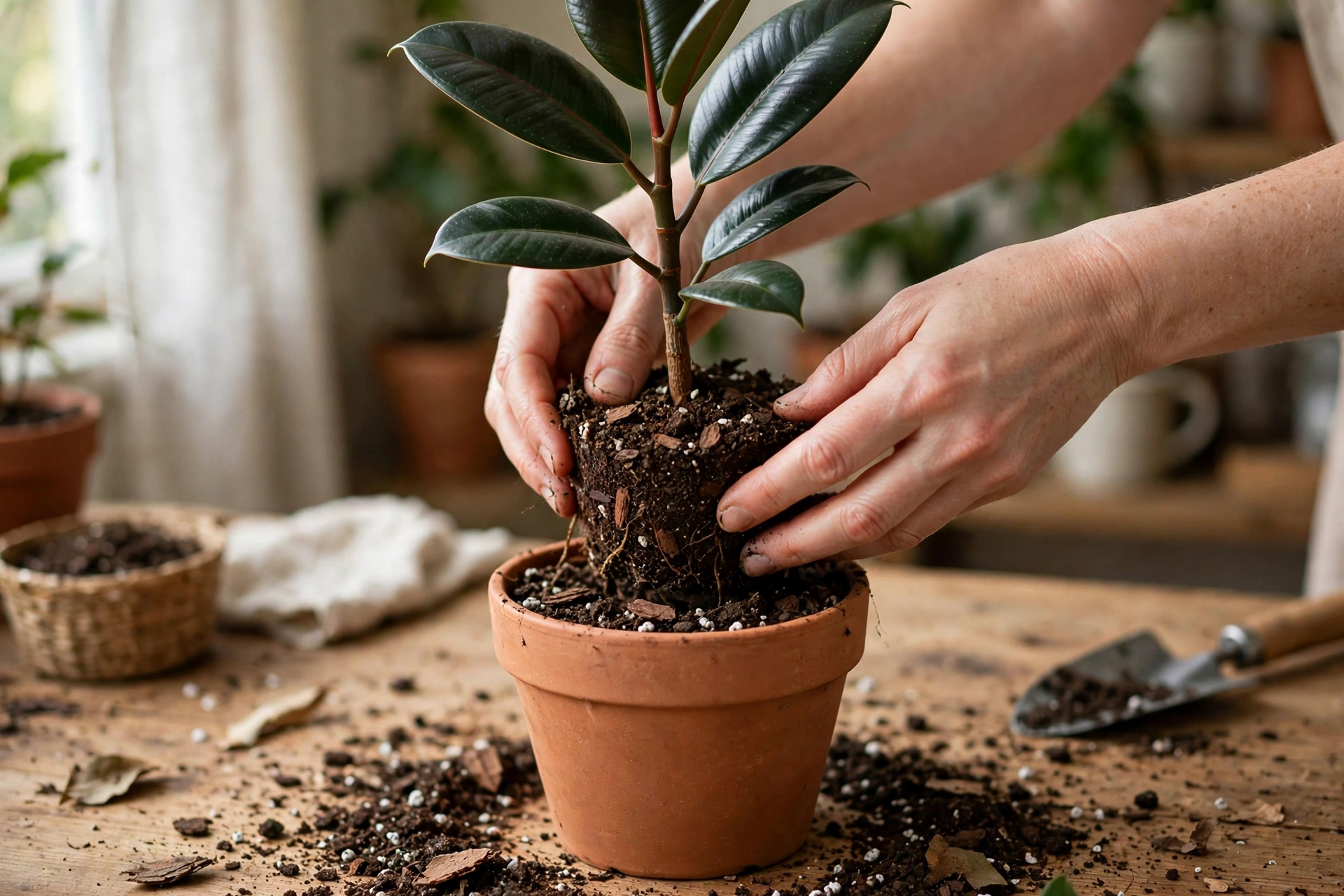
Use a free-draining mix with perlite or bark, and a pot with drainage holes. Set the plant at the same depth as before, water it in well, and keep it out of direct sun for a week. Repotting is the least frequent of the 10 rubber plant care tips, and doing it too often, or into a pot far too big, leaves the roots in soggy soil.
Tip 8: Give It a Little Humidity
Rubber plants cope fine with average home humidity, which is part of their charm, but they grow best when the air is not bone dry — aim for around 40 to 50 percent. In a heated winter home, grouping plants together or a pebble tray with water helps.
Brown, crispy leaf edges in winter usually mean the air is too dry, not that the plant needs more water. A small humidifier near your plants in the coldest months solves it, and the 10 rubber plant care tips work best when the air is not fighting the plant.
Tip 9: Watch for Common Pests
Rubber plants are fairly pest-resistant, but spider mites, mealybugs and scale can still show up on a stressed plant in dry air. Check the leaf joints and undersides when you wipe the leaves: mealybugs look like tiny tufts of cotton wool, scale like small brown bumps, and spider mites leave fine webbing and speckled leaves.
If you find pests, isolate the plant and wipe the insects off with a damp cloth or a cotton bud dipped in rubbing alcohol. A gentle insecticidal soap spray works for a stubborn case. Repeat weekly for a few weeks, because eggs hatch after the first pass — pest checks are part of the 10 rubber plant care tips for a reason.
Tip 10: Rotate It Every Few Weeks
Rubber plants lean toward the light, and one that never moves grows lopsided. Give the pot a quarter turn every couple of weeks so every side gets its share of light — it takes five seconds and keeps the stem straight.
This matters most for tall plants in a corner, where one side faces the room. Regular rotation is the easiest of the 10 rubber plant care tips, and it is the one most people forget — until their tree starts leaning.
Common Rubber Plant Problems and Fixes
Even with the 10 rubber plant care tips, a rubber plant can run into trouble — here is how to fix the usual problems.
Leaves dropping. The most common cause is overwatering, followed by a cold draught. If the soil is wet and leaves yellow as they fall, let it dry out and water less. If the soil is fine, look for a draught or a recent move — rubber plants drop leaves when their spot changes suddenly.
Brown leaf edges. Usually dry air or underwatering, sometimes mineral salts from hard tap water. Raise the humidity, water more consistently, and flush the soil with plain water every few months to wash salts out.
Leggy, sparse growth. Low light. Move the plant closer to a bright window and prune the top in spring to encourage branching. New growth will be tighter and fuller if the light is right.
Yellow leaves. Almost always too much water. Let the soil dry out more between waterings and check that the pot drains freely. One or two yellow lower leaves now and then are normal, but several at once means the roots are too wet.
Sticky leaves or black sooty patches. This points to scale insects or aphids, which leave sticky honeydew behind. Wipe the leaves clean and treat the pests as in Tip 9. Compared with the famously fussy fiddle leaf fig, the rubber plant is far more forgiving — if you have tried fiddle leaf fig care and struggled, the rubber plant is a kinder next step.
How to Style a Rubber Plant in a Small Space
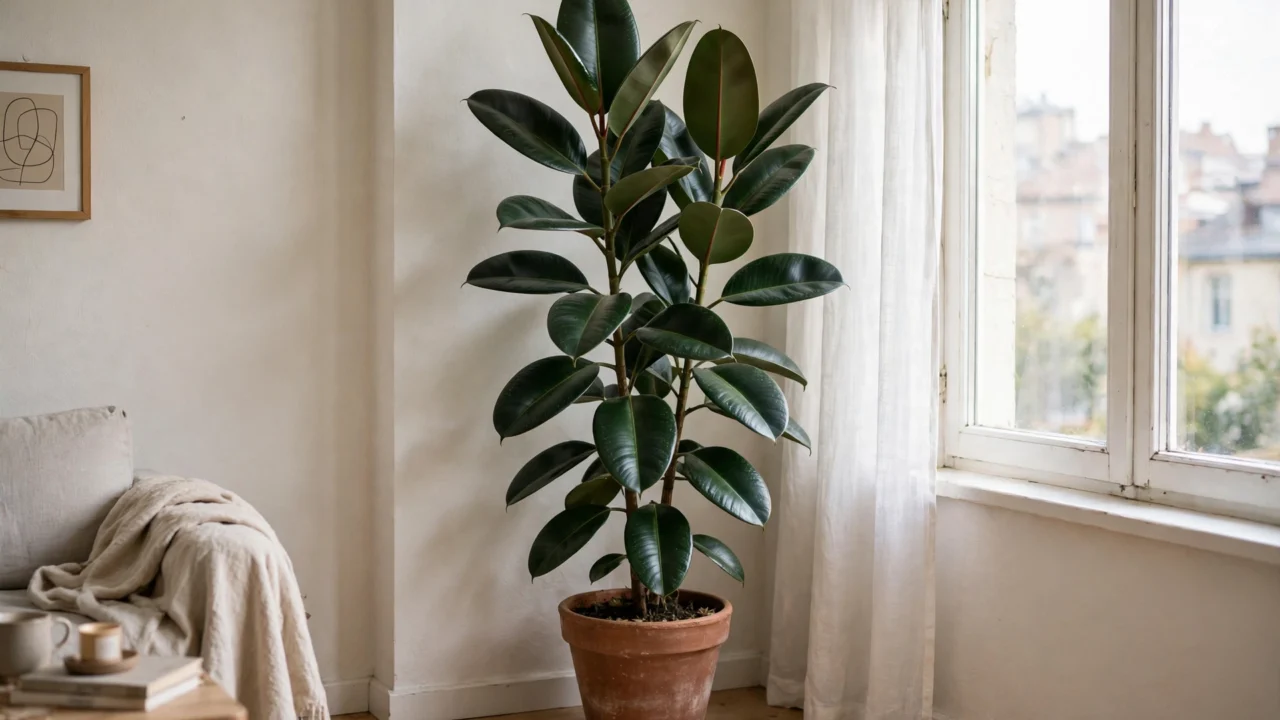
A rubber plant is a natural statement plant, and in a small space it does the work of several smaller plants at once. Place a tall one in an empty corner, in a woven basket or a simple ceramic pot, and let it anchor the room.
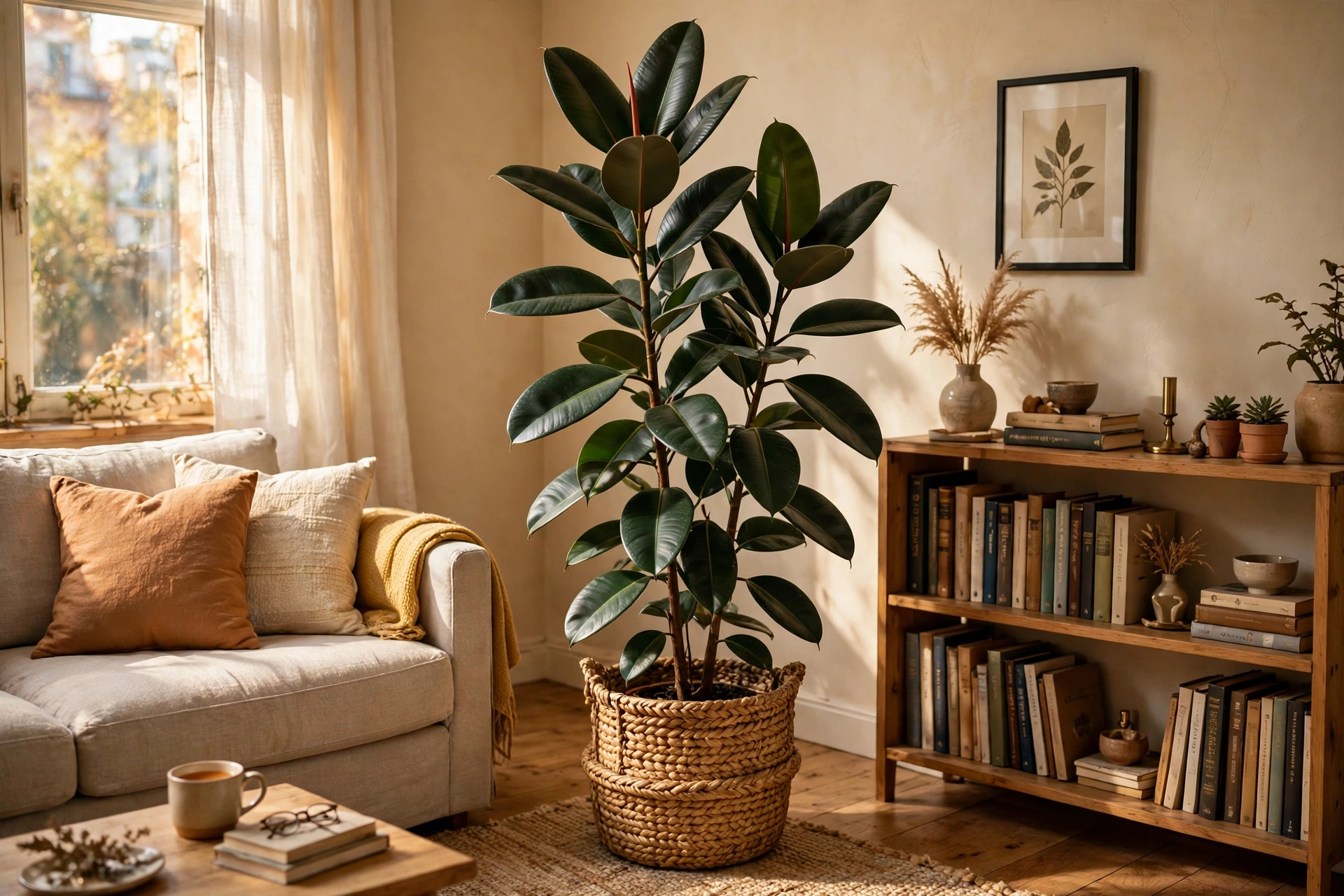
Keep the scale honest: a plant taller than you will overwhelm a tiny room, so prune the top each spring to hold it at the height you want. Pair it with one or two low plants, like a trailing pothos on a shelf above it, so it reads as part of a collection. The deep green or burgundy leaves suit warm wood, cream walls and terracotta pots.
If your rubber plant outgrows its corner, take a cutting from the top and start a second, smaller plant for a desk or windowsill — that way the plant keeps giving, even in the smallest home, and the 10 rubber plant care tips keep working for you.
Rubber Plant Care FAQs
Why is my rubber plant dropping leaves?
The usual causes are overwatering, a cold draught or a sudden move. If the soil is soggy, let it dry out and water less often. If the soil is fine, move the plant away from draughty doors and windows and give it a few weeks to settle.
How often should I water a rubber plant?
The 10 rubber plant care tips keep watering simple: water when the top two inches of soil feel dry, usually every one to two weeks in summer and every two to three weeks in winter. Always water thoroughly until a little drains out, then empty the saucer. The finger test matters more than any calendar.
How tall will a rubber plant grow indoors?
Indoors a rubber plant can reach six to ten feet over several years, though it grows slowly — often just a foot or so a year. Prune the top each spring to keep it at the height you want.
Do the 10 rubber plant care tips work for variegated rubber plants?
Yes, these 10 rubber plant care tips work for variegated forms like Tineke and Ruby, with one change: they need brighter light to keep their cream and pink colours. Give them the brightest indirect light you have, and water and feed them the same way.
Is a rubber plant safe around pets?
Rubber plants are mildly toxic if chewed, because the milky sap irritates mouths and stomachs. Keep the plant out of reach of pets that chew leaves, and wear gloves when you prune.
Your Rubber Plant, Glossy and Growing
The rubber plant earns its place as a statement plant the honest way: big glossy leaves, steady growth and very little fuss. These 10 rubber plant care tips are not complicated — bright indirect light, water only when the soil dries, warmth, clean leaves and a little pruning each spring.
Start with the light and the watering, because those two shape everything else. Once those are right, the rest of the 10 rubber plant care tips fall into place, and your rubber plant will quietly become the plant visitors ask about first.