
Here’s something most homeowners never think about until it’s too late: your driveway is the single largest visible surface on your entire property bigger than your front door, bigger than your porch, often bigger than your lawn. And yet it’s usually the last thing anyone landscapes.
That’s the opportunity. A driveway that’s been thought through, not just poured changes the entire first impression of a home before a guest even reaches the door. You don’t need to repave anything to get there, either. Most of the ideas below work with the driveway you already have.
Save this list idea #9 below is the one landscape designers say makes the single biggest difference on a tight budget, and it’s easy to miss if you skim.
Here are 15 driveway landscaping ideas, grouped from simple border upgrades to full layout transformations.
Quick Answer: The Fastest Way to Upgrade a Driveway
If you’re short on time and budget, start with a defined edge. A clean stone, brick, or steel border along both sides of your driveway paired with mulch and a few low, hardy plants solves the single biggest thing that makes driveways look unfinished: creeping grass and blurred edges. Everything else on this list builds from there.
Before You Start: 3 Things to Check First
- Map your drainage. Grading and slope determine where water goes. Plant beds placed in a low spot will stay soggy no matter what you put in them.
- Confirm your turning radius. Any curve or island you add needs to be tested against how your car (and any larger delivery vehicles) actually turns.
- Check sightlines on the street. Tall plants or structures near the driveway entrance can block visibility for cars pulling out and keep the first several feet low.
With that groundwork covered, here are 15 ways to transform the space.
Border & Edging Ideas
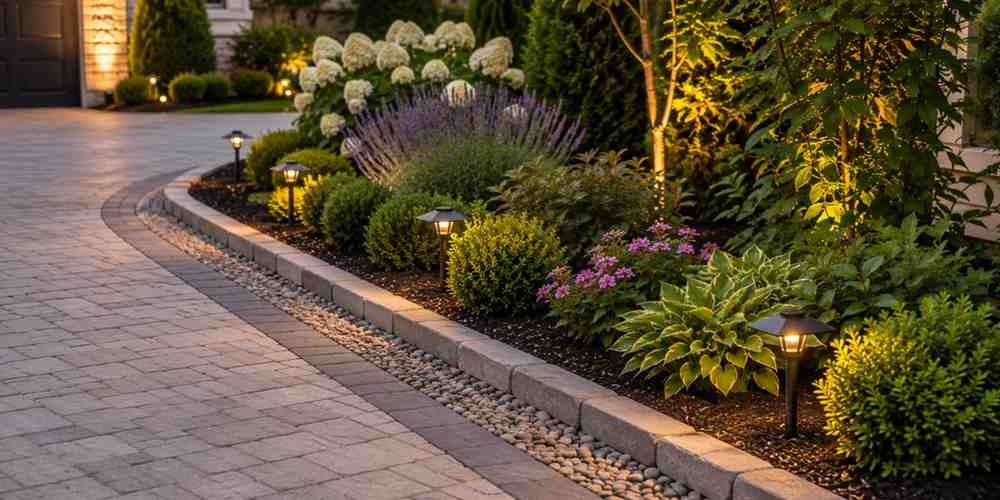
The fastest, most cost-effective upgrades on this list and the foundation everything else builds on.
1. Defined Stone or Paver Edging
A hard border along the driveway’s length is the single detail that makes the whole space read as designed rather than default.
- Stone, brick, or concrete edge restraints keep gravel, mulch, or grass from spilling onto the pavement.
- Choose a material that echoes something already on your house brick edging next to a brick home, for example to tie the whole property together visually.
- This upgrade is one of the most budget-friendly on the list and can often be done in a weekend.
2. Mulched Planting Strip
A simple mulched border along the driveway edge is inexpensive, low-effort, and instantly cleans up the transition between pavement and lawn.
- Line the edge with mulch, then plant flowers spaced evenly for a polished, uncluttered look.
- Water consistently through the growing season, especially in the first year while plants establish.
- Works well as a standalone upgrade or as the base layer under taller plantings.
3. Brick Tire-Path With Grass Strips
For a driveway that stays mostly green, brick or paver strips laid where your tires actually roll with grass growing between and around them keeps most of the surface planted while still supporting vehicle weight.
- This works especially well on small lots where you want to avoid a solid slab of pavement.
- The brick holds up structurally while the grass keeps the overall space feeling fresh and less hardscaped.
- Pair with mowing-friendly curves so the grass stays easy to maintain.
4. Low Hedge Border
A tightly clipped low hedge boxwood or dwarf evergreen along the driveway edge adds structure without blocking sightlines.
- Choose plants that stay tidy on their own and won’t drop excessive leaves, berries, or sap onto the pavement.
- Keep the hedge height low near the street entrance for visibility, and let it rise slightly closer to the house.
- This is a higher-upkeep option than mulch or gravel, but it delivers a distinctly formal, finished look.
Quick recap: every border idea above solves the same core problem: a driveway without a defined edge always looks unfinished, no matter what else you add.
Read More: 15 Kitchen Garden Ideas for Small Spaces That Actually Produce Food
Planting & Greenery Ideas
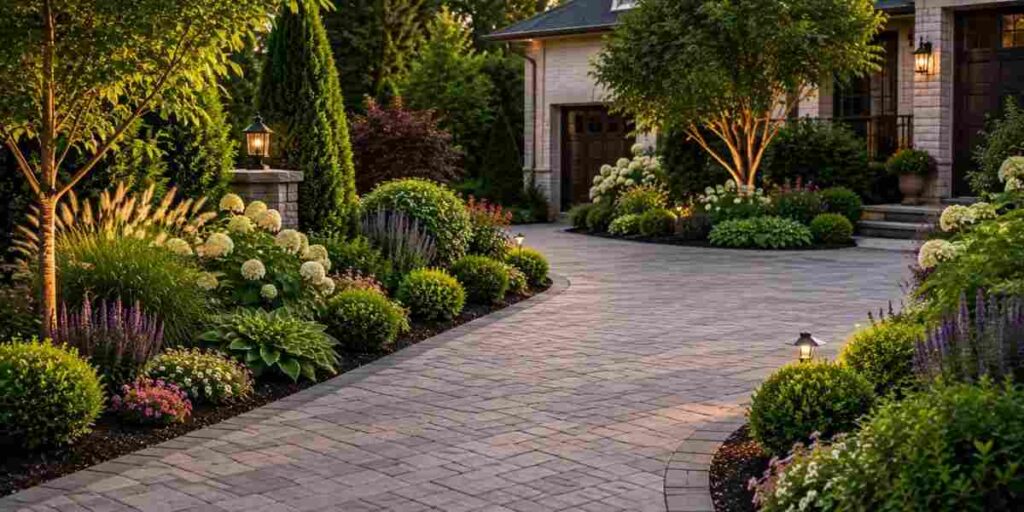
Here’s the thing: a driveway surrounded by the right plants stops looking like pure function and starts looking like part of the garden.
5. Perennial Color Border
Hardy perennials, daylilies, black-eyed Susans, peonies planted along the driveway edge bloom back reliably year after year with minimal replanting cost.
- Space plants evenly for a polished, intentional look rather than a scattered one.
- Choose bloom times that stagger through the season so the border isn’t full one month and bare the next.
- This is one of the lowest lifetime-cost upgrades on the list once plants are established.
6. Evergreen Structure Planting
Evergreens frame a driveway beautifully and unlike flowering plants hold their shape and color through winter when everything else looks bare.
- Tall, narrow options like cypress or thuja create a formal, symmetrical look on longer driveways.
- Smaller evergreen varieties soften the edges of shorter or narrower driveways without overwhelming the space.
- Mixing evergreens with seasonal color elsewhere gives you structure and variety in the same landscape.
7. Ornamental Grass Drifts
Grouped ornamental grasses along a driveway add movement and texture that most driveway plantings miss entirely.
- Grasses sway in the breeze, which keeps a straight driveway from feeling static or overly rigid.
- Pair soft grasses next to hard materials like stone or concrete edging for a contrast that reads as intentional, layered design.
- Most ornamental grasses are drought-tolerant once established, keeping this a genuinely low-maintenance option.
8. Tree-Lined Approach
For longer driveways especially, evenly spaced columnar trees on both sides create a formal, almost ceremonial approach to the house.
- Match tree scale to your driveway’s length; a short driveway can be overwhelmed by large trees planted too close together.
- Underplant with low, tidy shrubs or groundcover so the base doesn’t look bare while the trees mature.
- This is a longer-term investment most impact builds over several years as the trees fill in.
Hardscape & Material Ideas
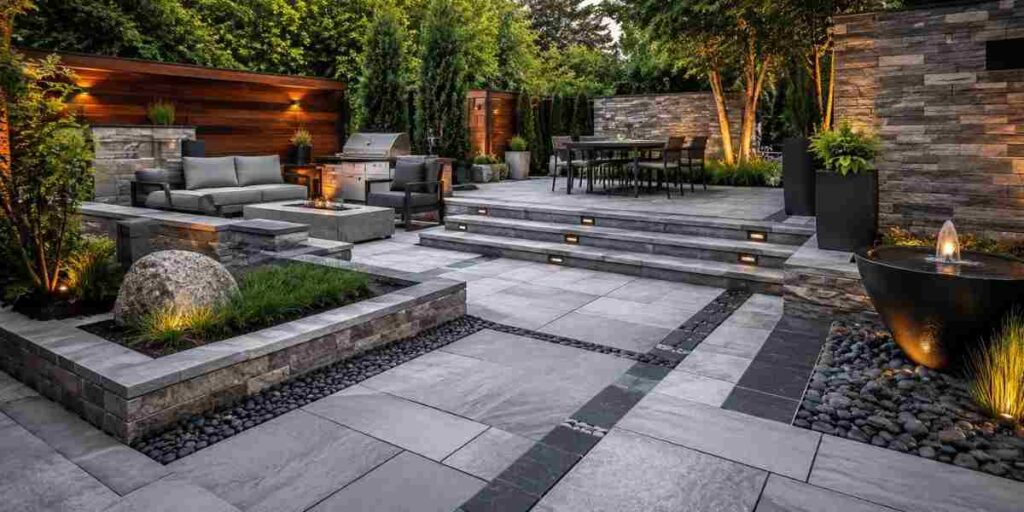
These four ideas focus on what’s actually under your tires, not just what surrounds it.
9. Decorative Gravel
This is the upgrade most homeowners skip because it sounds too simple to matter and it’s exactly why landscape designers point to it first for tight budgets. Decorative gravel is inexpensive, improves drainage, and instantly adds texture and color variation compared to plain concrete or asphalt.
- Choose a gravel color and size that complements your home’s exterior rather than just grabbing whatever’s cheapest.
- Spread evenly along driveway sides or fill entire sections, and use edging to keep material from migrating into the lawn.
- Gravel is also one of the easiest materials to refresh later if it gets compacted or discolored over time.
10. Mixed Paver Pattern
Combining different paver sizes and shapes creates a modern, custom pattern that plain concrete slabs simply can’t match.
- If the budget is limited, install the pattern only at the driveway entrance and keep the rest of the surface simple; it still reads as an upgrade from the street.
- Vary paver orientation (herringbone, basketweave) for visual interest without needing multiple colors.
- Pavers are also easier to repair individually than a poured slab, since a single damaged paver can be swapped out.
11. Permeable Paver Grid
For circular driveways, sloped sites, or anywhere drainage is a concern, permeable grid pavers let gravel or grass grow through a structural grid that resists rutting under vehicle weight.
- This is especially useful under tight turning radiuses, where standard gravel alone tends to shift and rut.
- Permeable systems also reduce runoff, which helps protect nearby planting beds from washout.
- Works well combined with idea #3 (brick tire paths) for a driveway that stays mostly green.
12. Stamped Concrete Finish
Stamped concrete mimics the look of brick, stone, or slate at a lower cost than the real materials, while still holding up to heavy vehicle use for decades.
- A strong option for long, straight driveways where poured concrete is the most practical base material.
- Choose a pattern that echoes materials already used elsewhere on the property, a walkway or patio, for example for a cohesive look.
- Requires periodic resealing to keep the pattern and color looking crisp over time.
Layout-Specific & Functional Ideas
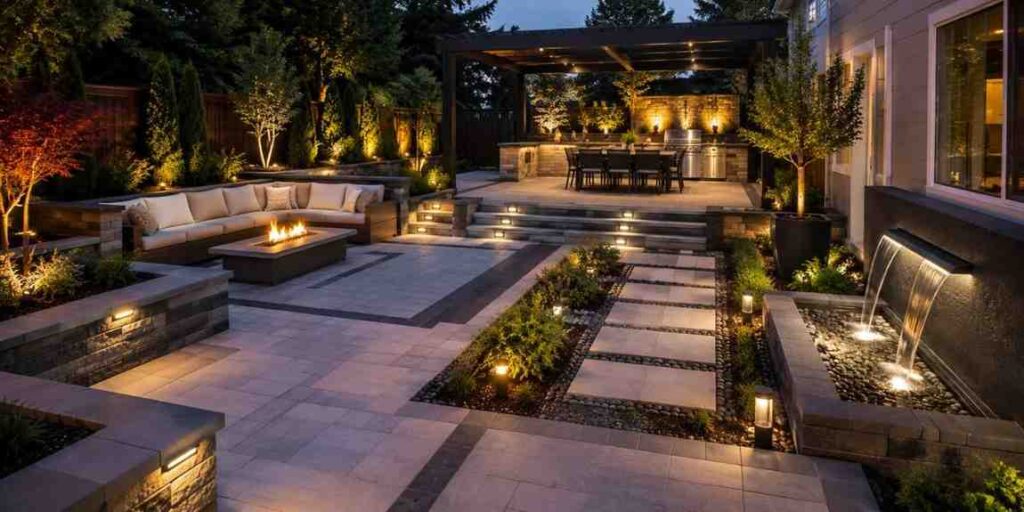
The last three ideas solve specific driveway shapes and everyday practical problems.
13. Circular Driveway With Center Island
A circular or semi-circular driveway improves both curb appeal and traffic flow, letting cars enter and exit without reversing into the street.
- Full circles typically need significant depth to function properly, while semi-circular designs work on narrower lots by connecting two curb points with a sweeping arc.
- The center island is prime landscaping real estate: a specimen tree, garden bed, or small fountain all work well here.
- Downward-facing lighting spaced evenly along the outer curve improves nighttime visibility and reduces glare for arriving cars.
14. Narrow Driveway Courtyard End
On a tight or narrow lot, transforming the end of the driveway into a small gathering spot, stone slabs over gravel, a fire feature, soft grasses, turns a purely functional space into a destination.
- Large stone slabs help visually widen a narrow driveway by drawing the eye forward rather than emphasizing its width.
- Keep the planting palette soft and layered rather than dense, so the space still feels open.
- This idea works especially well for driveways that dead-end at a garage or side yard rather than looping back to the street.
15. Layered Lighting Design
Lighting is one of the most affordable driveway upgrades available, and it does double duty: safety and style.
- Low path lights along the edges guide movement and outline curves after dark.
- Uplighting a specimen tree or focal shrub adds a dramatic touch without lighting the entire driveway surface.
- Test light spacing at night before finalizing placement; too few fixtures leave dark gaps, too many can wash out the effect.
Frequently Asked Questions
What’s the cheapest way to improve driveway landscaping?
Decorative gravel and a defined edge border are generally the two most budget-friendly upgrades, since both avoid the cost of repaving while still visibly cleaning up the space.
How do I landscape a narrow driveway without making it feel smaller?
Keep plantings low and layered rather than dense, use light-colored materials like pale gravel or light stone to visually open the space, and consider a courtyard-style end point (see idea #14) to give the eye a destination.
What plants work best along a driveway edge?
Hardy, low-maintenance options like daylilies, black-eyed Susans, ornamental grasses, and dwarf evergreens are common choices, since they tolerate reflected heat from pavement and don’t require constant upkeep.
Do I need a landscape professional for a circular driveway?
Circular and semi-circular layouts involve grading, drainage, and turning-radius calculations, so while simple planting upgrades are DIY-friendly, changes to the driveway’s actual layout usually benefit from professional input.
How much can driveway landscaping increase home value?
Well-executed driveway and curb-appeal landscaping is frequently cited as a meaningful factor in perceived home value, though the exact impact varies by market, materials chosen, and overall project scope.
Bringing It All Together
Your driveway doesn’t have to be an afterthought squeezed between the street and the garage door. With a defined edge, the right plant mix, and a material choice that fits your budget, it can become one of the most memorable parts of your home’s approach.