
You know that moment when the sun dips below the fence line and your beautiful garden just… disappears? All that work, the flowers, the stone edging, the little path you fought to keep weed-free vanishes into the dark by 8 p.m.
Here’s the good news: fixing that doesn’t require an electrician, a trench, or a single wire. It just takes the right solar lights in the right spots. And by the time you get to idea #9 below, you’ll probably already be rethinking your whole layout that one tends to surprise people the most.
Save this guide before you go shopping. You’ll want to come back to it once you’re standing in the garden aisle staring at forty different stake lights.
Let’s walk through 15 solar garden light ideas that turn a plain pathway into the kind of space you actually want to be in after dark.
1. Classic Solar Stake Lights, Spaced for Rhythm
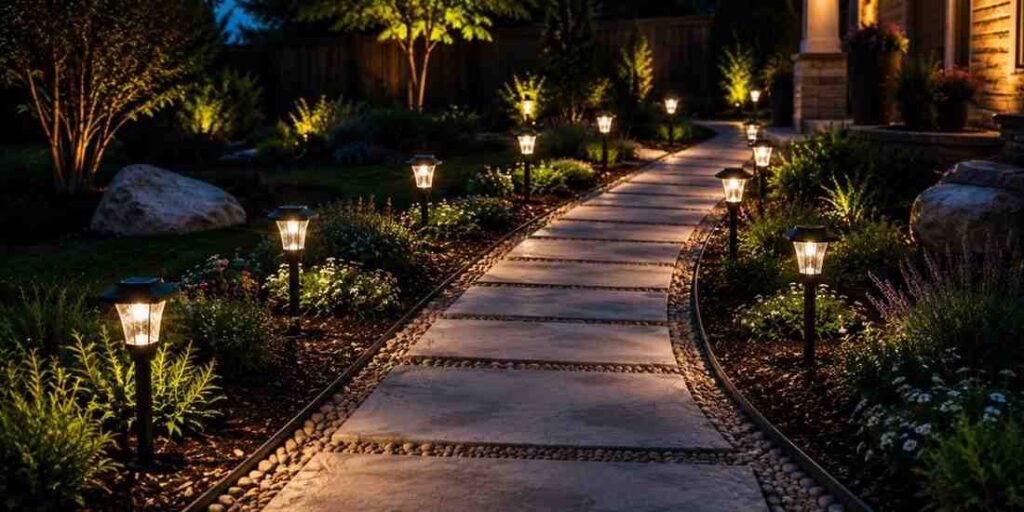
This is the foundation almost every glowing pathway starts with and for good reason. Simple stake lights pushed into the soil on either side of a walkway create a steady, welcoming rhythm that guides the eye (and your feet) straight to the front door.
Here’s the thing: spacing matters more than the lights themselves. Too close together and the path looks like a runway; too far apart and you get awkward dark gaps. Aim for 2.5 to 3 feet between fixtures, alternating sides for a softer, more natural glow instead of two rigid lines.
2. Shepherd Hooks with Hanging Lanterns
Swap the ground stakes for shepherd hooks topped with small hanging lanterns, and your path instantly picks up a softer, more romantic feel. The light source sits higher, so it casts a gentler pool of glow rather than a sharp beam at ankle height.
This idea works beautifully for cottage gardens, gravel paths, and anywhere you want a slightly old-world, storybook feeling. Space the hooks a bit wider than stake lights around 4 feet since the elevated light throws a wider circle.
3. Mandala-Pattern Ground Projector Lights
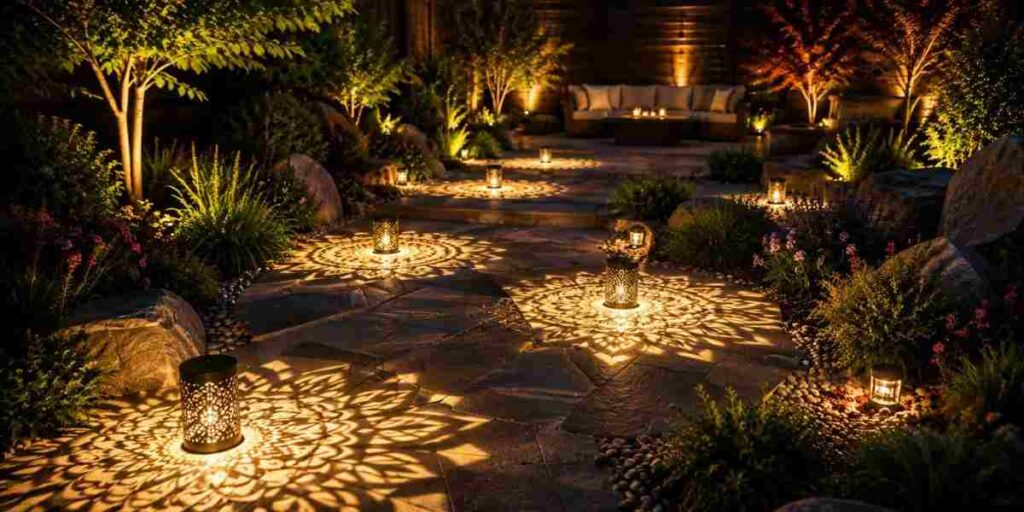
But there’s a catch most people miss: not all pathway lights just shine light straight down. Some solar stakes are designed with cut-out patterns in the shade that project intricate shapes, starbursts, mandalas, even leaf silhouettes onto the ground below.
The effect is genuinely unexpected. Instead of a plain circle of light, you get a little pattern glowing at your feet with every step, almost like the garden is putting on a quiet light show. These are a favorite for anyone who wants their path to feel a little more magical without adding a single extra fixture.
4. Solar Strip Lights Along Bed Edges
If you like clean, modern lines, solar strip lights adhered along the edge of a raised bed or path border are worth a look. They define the boundary of the walkway and light it at the same time, without a single visible stake breaking up the view.
This is one of the sleekest solar garden light ideas for a contemporary landscape, think crisp architectural gardens rather than cottage charm. Because the light source is low and continuous, it reads as a soft glowing line rather than individual dots.
Read More :15 Driveway Landscaping Ideas That Turn a Parking Strip Into a Grand Entrance
5. Solar Bollard Lights for a Structured, Upscale Look
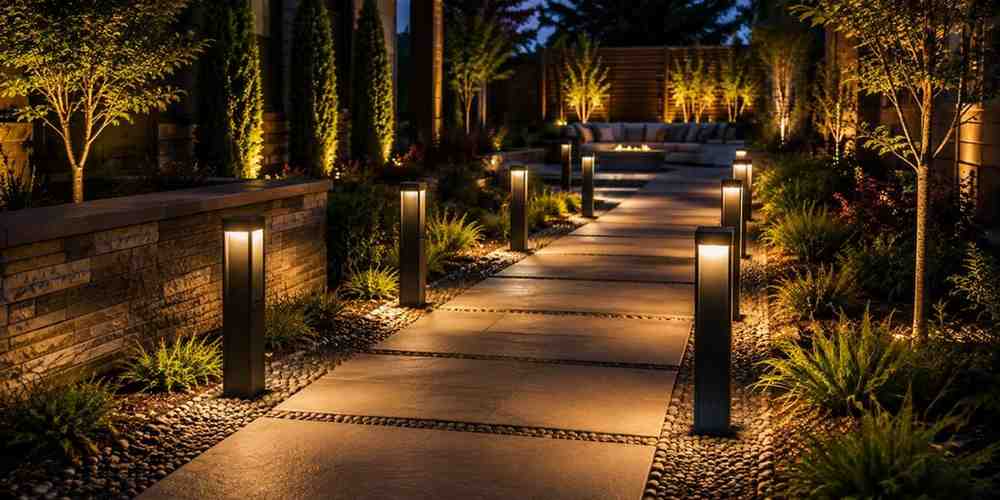
Bollard lights are the taller, sturdier cousins of the basic stake light upright fixtures that stand 12 to 24 inches tall and cast light both downward and outward. They give a pathway a more finished, almost commercial-landscaping look.
Quick summary: bollards work best where you want visibility and style driveway edges, front-entry walks, or anywhere guests will actually be walking after dark. They’re sturdier in wind than thin stakes, too, which matters if your yard gets gusty evenings.
6. Flush-Mounted Solar Deck Lights on Path Edging
Originally designed for decks, these low-profile solar disks also work beautifully embedded into paver edging or stone borders along a path. They sit flush with the surface, so there’s nothing to trip over and nothing sticking up to mow around.
The light they give off is soft and diffused rather than bright, perfect for marking the edge of a path without overpowering the rest of your garden lighting.
7. A Zigzag Lantern Path Instead of a Straight Line
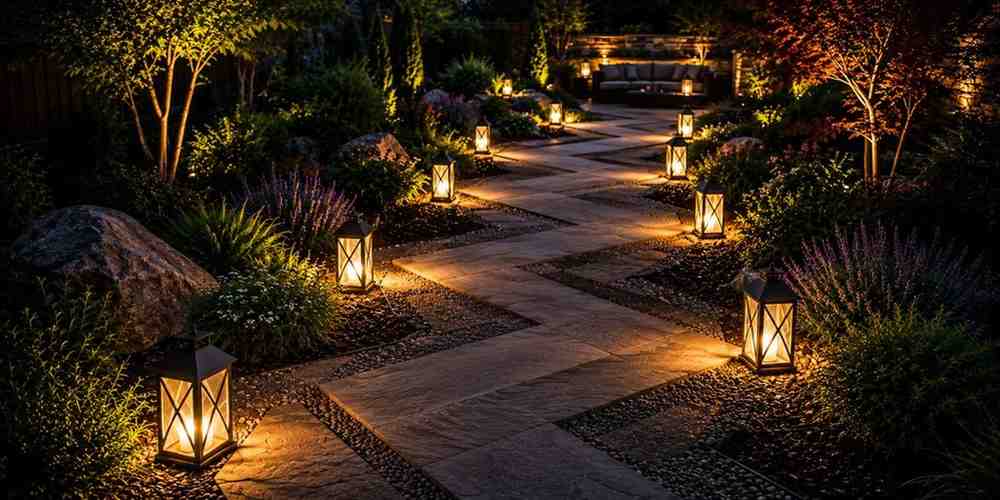
Here’s a small tweak that changes the whole mood: instead of lining lanterns in two straight rows, stagger them in a loose zigzag down the path. It creates dynamic shadows and a sense of movement, and it’s especially striking on winding or curved walkways.
This is a great pick if your path already curves through garden beds rather than running in a straight shot the zigzag lighting pattern echoes that natural, meandering feel instead of fighting it.
8. Faux-Stone or Rock-Style Solar Lights
For anyone who wants light without looking like they added light, faux-rock solar fixtures are a genius little trick. They’re molded to look like natural stones, tucked right into the border of the path or nestled among ground cover, glowing softly at dusk.
Save this one for later if you have a naturalistic or woodland-style garden; these blend in during the day and only reveal themselves once the sun goes down.
9. Solar Fairy Lights Draped Along a Fence Bordering the Path
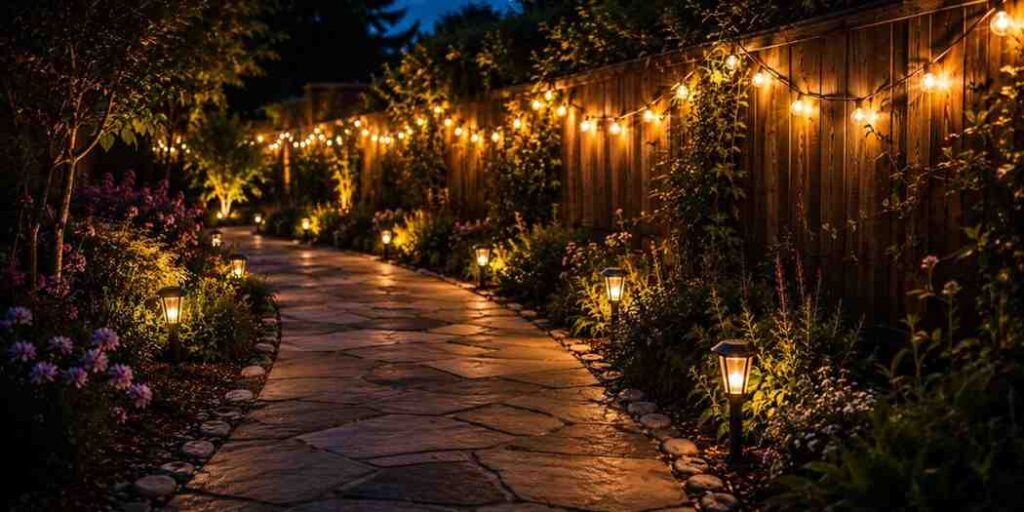
This is the idea we teased at the top, the one that tends to surprise people the most. If your pathway runs alongside a fence, trellis, or low hedge, draping solar fairy string lights along it adds an entirely different layer of ambiance above the ground-level path lights.
The combination is what makes it work: stake lights guide the feet, and the fairy lights above create atmosphere. Together, the path stops feeling like a lit walkway and starts feeling like an event space.
10. Solar Firefly Lights Scattered Through Nearby Plantings
Tiny, flexible strands of solar firefly lights mimic the soft, random flicker of real fireflies when tucked into the plants bordering your path. Weave them through low shrubs, ornamental grasses, or ground cover along the walkway for a subtle, magical layer of light that complements rather than competes with your main pathway fixtures.
They’re inexpensive, easy to move, and one of the fastest ways to make an ordinary evening walk to the mailbox feel a little enchanted.
11. Solar Spotlights Aimed Up Into Trees Along the Path
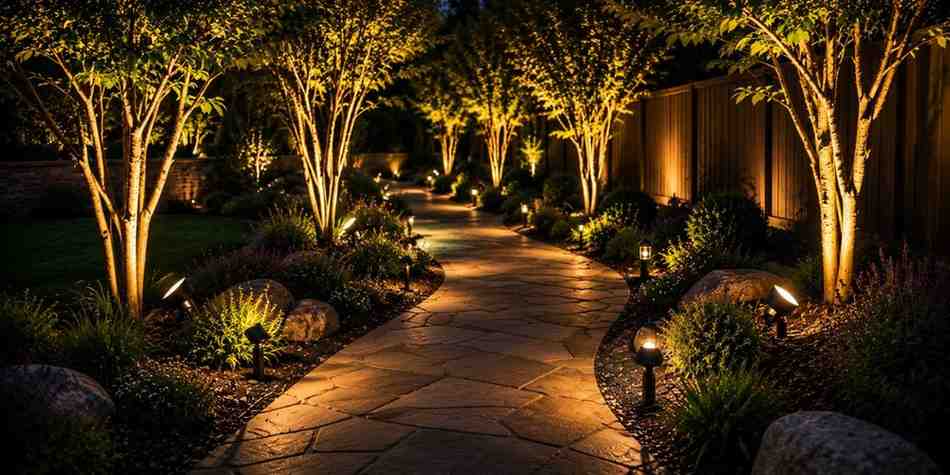
Not every light along a path needs to point down. Solar spike spotlights angled upward into a tree, shrub, or garden statue near the walkway create dramatic shadows and depth, turning a flat, evenly lit path into something with real dimension.
This technique, sometimes called uplighting, is a favorite among professional landscapers, and it’s just as achievable with solar spikes as it is with wired fixtures. Pick one or two focal points rather than uplighting everything; restraint is what makes it look intentional.
12. Minimalist Modern Bollards for a Sleek, Architectural Path
If your home leans modern clean lines, neutral tones, minimal ornamentation skip the lantern-style fixtures and go with slim, matte-black or brushed-steel bollards instead. Spaced evenly and kept low-profile, they read as architectural rather than decorative, which suits contemporary hardscaping perfectly.
Quick summary: ornate for cottage gardens, minimalist for modern ones matching your fixture style to your home’s overall aesthetic is what separates a pathway that looks “done” from one that looks like an afterthought.
13. Solar Glass Globe or Mason-Jar Style Lights
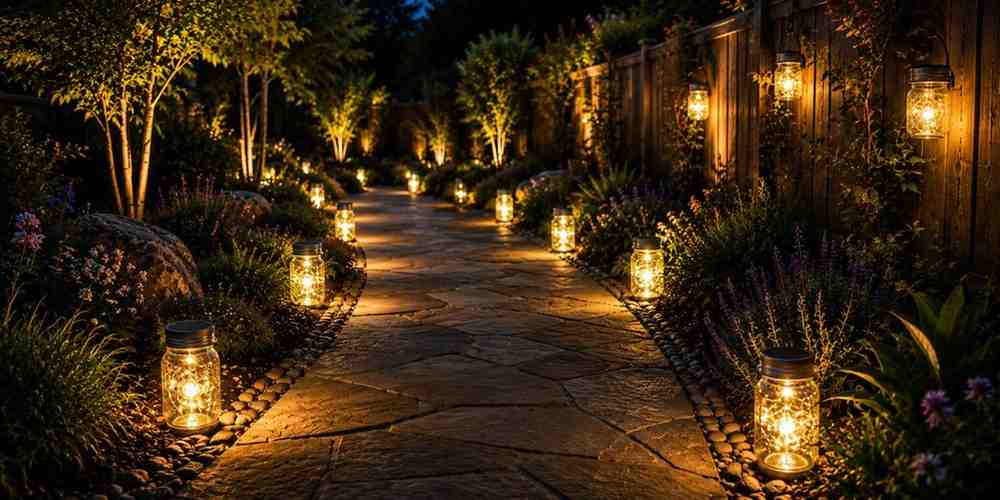
Glass globe stakes and mason-jar-style solar lights bring texture and a bit of vintage charm to a path. During the day, the glass catches sunlight like a little garden ornament; at night, it glows from within with a warm, ambient light rather than a sharp beam.
These pair especially well with idea #2 (shepherd hooks) if you want to mix a couple of hanging glass lanterns in with your ground-level stakes for varied height and texture.
14. Solar Motion-Sensor Lights at Entry Points and Steps
Here’s a practical one to balance out all the ambiance: motion-sensor solar lights at the start of the path, near steps, or at a gate. They stay dim (or off) most of the time to conserve energy, then brighten automatically when someone approaches genuinely useful for safety, not just style.
Placing these at transition points at the top of a step, a change in path direction, a gate is one of the most overlooked but most functional solar garden light ideas for a pathway, especially if anyone in your household has trouble seeing uneven ground at night.
15. Color-Changing Smart Solar Lights for Special Occasions
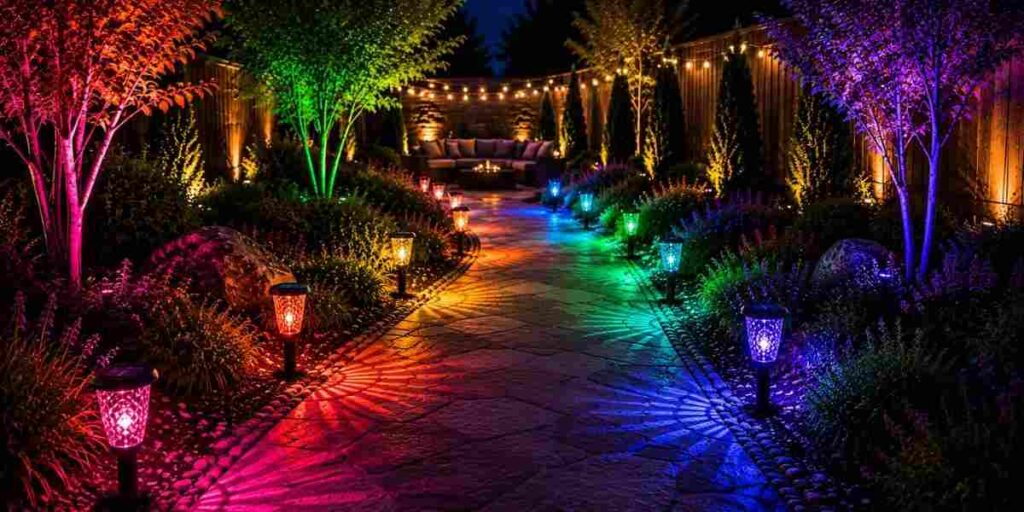
For a path that can shift moods, color-changing solar lights controlled by an app let you switch from soft warm white on a regular evening to a festive color scheme for a birthday, holiday, or backyard party with no rewiring, no extra fixtures to buy for each season.
This is the most flexible pick on the list: one set of lights, endless looks. It’s a smart way to future-proof your pathway lighting without committing to a single style forever.
How Many Solar Lights Does Your Pathway Actually Need?
A question that comes up constantly: how many lights for a typical path? As a rough guide, plan on one fixture every 2.5 to 3 feet per side for a straight walkway. So a 30-foot path would use roughly 10 to 12 lights per side, or 20 to 24 total if you’re lighting both edges.
For curved or zigzag layouts (idea #7), you can space fixtures a little closer on the inside of each curve to keep the light even.
Quick Tips Before You Buy
- Check the sun exposure first. Solar lights only work as well as the sunlight hitting their panel; a path that’s shaded most of the day will need brighter-rated fixtures or a repositioned panel.
- Mix heights and styles. Combining ground stakes with one or two taller lanterns or bollards (ideas #2, #5, #12) adds visual interest instead of a flat, uniform line.
- Look for IP65 waterproofing or higher if you live somewhere with real rain or snow. It’s the difference between lights that last one season and ones that last five.
- Warm white (2700–3000K) reads as cozy; cool white (5000K+) reads as modern and crisp. Pick based on the mood you actually want, not just what’s on sale.
Frequently Asked Questions
Do solar pathway lights work in winter or cloudy climates?
Yes, though output will be dimmer with less direct sun. Look for panels rated at 20% efficiency or higher and lights with backup battery capacity for cloudy stretches.
How long do solar garden lights typically last before charging fails?
Most rechargeable batteries in solar stake lights last 1–2 years before needing replacement, while the fixture itself, if well-made and weatherproof, can last several years longer.
Should pathway lights face the same direction as sunlight, or does it matter?
Placement for charging matters more than direction of the light beam itself, positioning the solar panel where it gets unobstructed sun for most of the day, even if that means angling the fixture slightly off from the path’s exact line.
Can I mix different styles of solar lights along the same path?
In fact, several ideas above (like pairing stake lights with shepherd-hook lanterns or fairy lights) work best when combined rather than used alone.
Bringing It All Together
A dark, forgettable pathway is one of the easiest things in your whole yard to fix and one of the most noticeable once it’s done. Whether you start with a simple row of stake lights or go all in with fairy lights, uplighting, and a motion-sensor entry point, every idea on this list runs on nothing but sunshine.