
There’s a particular kind of magic that happens the moment the sun dips below the horizon and your garden lights flicker on. Suddenly, that ordinary backyard becomes something else entirely pathways glow softly underfoot, tree canopies take on a dramatic silhouette, and a space that felt purely functional during the day turns genuinely enchanting at night.
The truth is, most gardens are designed with only daylight in mind, which means half of their potential the evening half goes completely unused. With the right lighting strategy, though, you don’t just extend the hours your garden is usable; you fundamentally change how it feels to be in. Below are 13 outdoor garden lighting ideas to help you turn your yard into an evening retreat, along with the practical know-how to execute each one well.
Why Garden Lighting Deserves as Much Thought as Daytime Landscaping
It’s easy to treat outdoor lighting as an afterthought a single floodlight by the back door, maybe a string of lights for parties. But thoughtful garden lighting does three things at once: it boosts safety by illuminating paths and steps, it adds real curb appeal and even property value, and it creates the kind of ambiance that makes people actually want to linger outside after dark.
The key principle worth remembering before you buy a single fixture: layered lighting beats a single bright source every time. Just like indoors, a garden benefits from a combination of ambient, task, and accent lighting working together not one harsh overhead light trying to do everything.
1. Wrap String Lights Around Trees, Trellises, or Railings
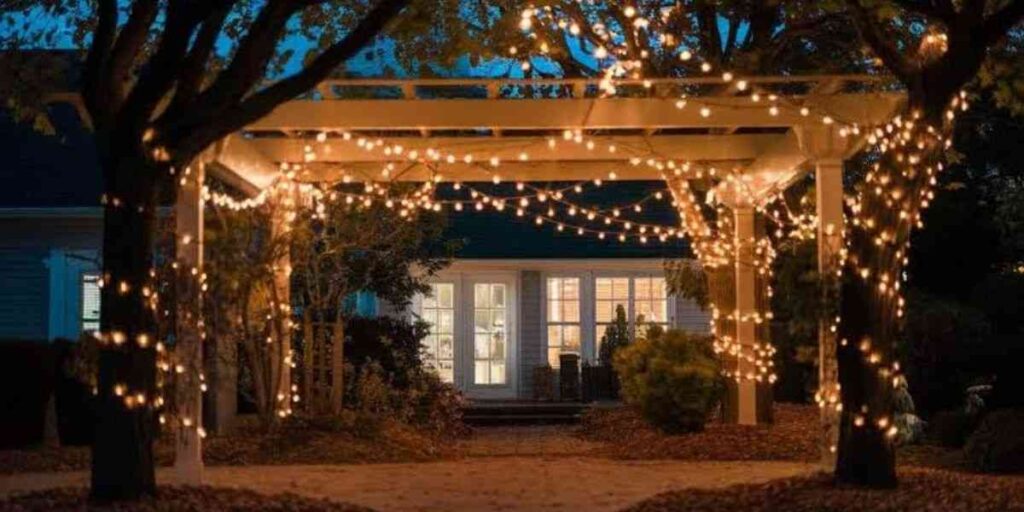
String lights remain one of the most popular and versatile forms of garden lighting, and it’s easy to see why they’re affordable, easy to install, and instantly add warmth to any space. Wrap them around tree trunks, weave them along a trellis, or drape them along deck railings for an unexpected focal point that feels effortless but photographs beautifully.
For a more vintage feel, swap standard mini bulbs for Edison-style or mercury glass bulbs, which add a warm, elegant glow reminiscent of old-world garden parties.
2. Use Uplighting to Dramatize Trees and Architectural Features
Uplighting placing a fixture at the base of a tree or structure and aiming it upward creates striking shadows and highlights texture in a way that overhead lighting simply can’t. This technique works especially well on mature trees, ornamental grasses, or architectural elements like stone walls or pergola posts, turning them into nighttime focal points rather than dark, forgettable shapes.
3. Install Low-Voltage Path Lighting to Guide the Way
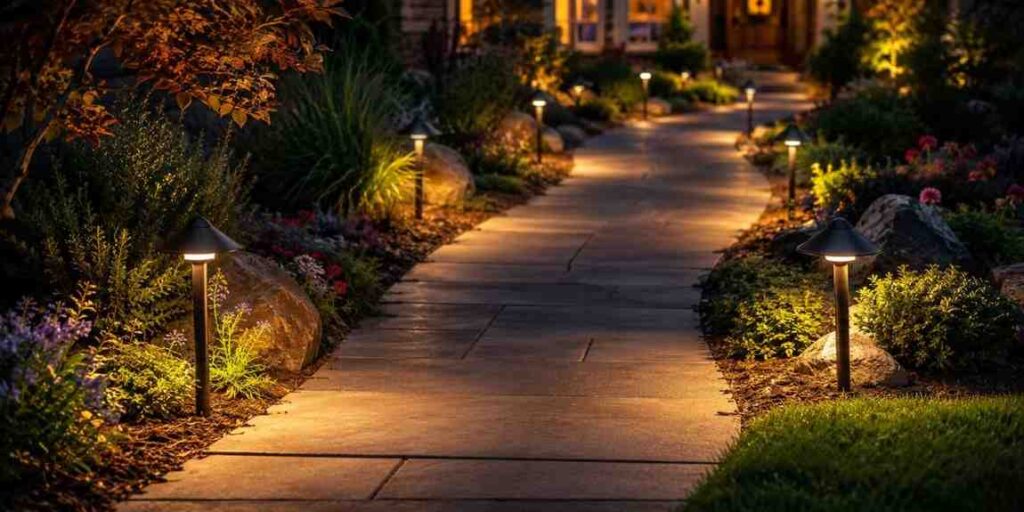
Soft, downward-facing path lights along a walkway or driveway do double duty: they guide guests safely to your door and add a subtle, welcoming glow to the whole approach. The key is restraint — avoid placing every fixture in a perfectly straight line, which can create an unflattering “runway” effect. Instead, stagger them slightly and vary the spacing for a more natural look.
Read More: 13 Front Porch Decorating Ideas That Will Make Your Neighbors Slow Down and Stare
4. Add Solar-Powered Fixtures for Easy, Wireless Installation
Solar garden lights have come a long way, offering decorative and functional lighting without any wiring or electrical work. They’re ideal for areas that get good sun exposure throughout the day and automatically switch on at dusk, making them one of the easiest lighting upgrades a homeowner can tackle in an afternoon.
5. Hang Lanterns From Shepherd’s Hooks, Trees, or Pergola Beams
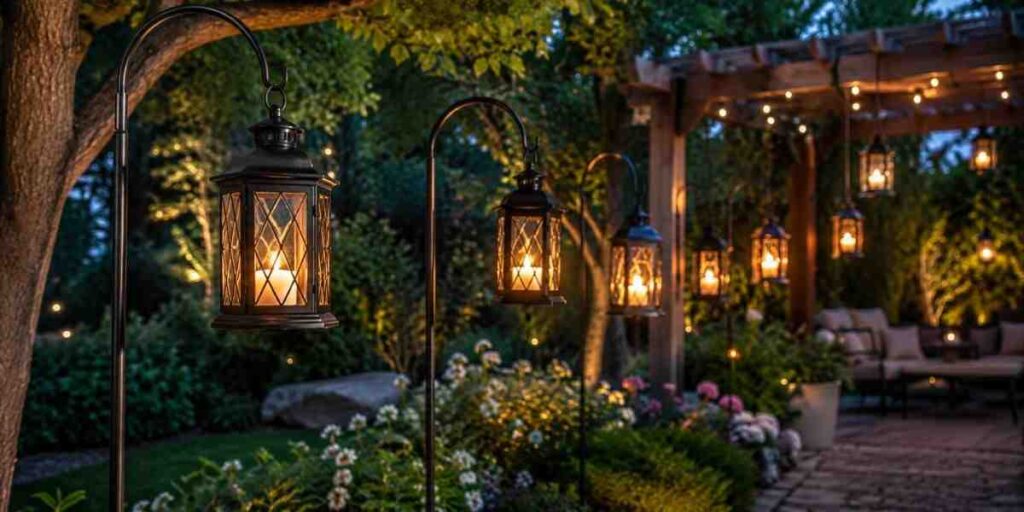
Lanterns bring a timeless, welcoming quality to a garden and work beautifully at multiple scales. Group smaller lanterns on a side table for intimate, close-range lighting near a seating area, or hang larger ones from posts to mark a pathway. For real visual drama, cluster several lanterns at varying heights in a tree the layered glow creates an instant landscape transformation.
6. Spotlight Your Garden’s Best Features
Not every plant needs to be lit but your garden’s true standout features deserve the spotlight, literally. A specimen tree, a striking flowering shrub, or a hardscape feature like a stone wall or fountain becomes a genuine nighttime focal point when accented with a well-aimed spotlight. Just be mindful of the angle: position fixtures so the beam highlights the feature rather than shining directly into windows (yours or a neighbor’s).
7. Layer Lighting Under Pergolas and Overhead Structures
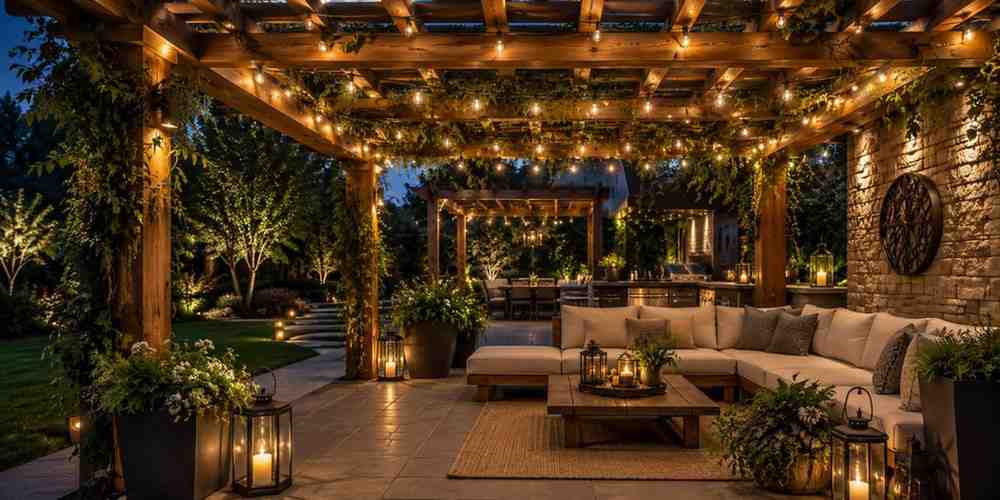
Pergolas and covered patios benefit enormously from layered lighting string lights, recessed cans, or decorative pendants can all transform an overhead structure into a true outdoor room. For a romantic mood, stick with warm Edison-style bulbs; for a more functional dining or conversation space, add focused downlights with dimming capability so you can adjust the mood as the evening goes on.
8. Add Rail-Mounted or Recessed Deck Lighting
For decks especially elevated ones rail-mounted fixtures, recessed deck lights, or strip lighting tucked under the cap rail create usable evening space while also softly illuminating the area underneath. This approach is particularly effective for multi-level decks, where the lighting helps define each level and prevents awkward, unlit transitions between them.
9. Use Flood or Spotlights for Larger Trees and Open Areas
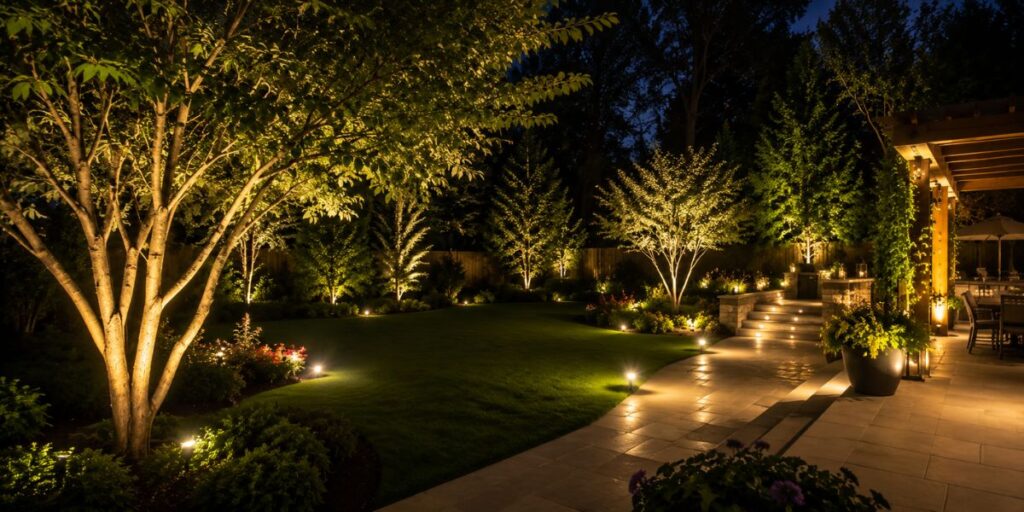
For bigger yards or larger trees that need more coverage than a single accent light can provide, flood lights and spotlights are the better tool for the job. Most are available in low-voltage, solar, or LED versions, which helps conserve energy while still reaching areas of the yard that are far from a power outlet.
10. Add Underwater Lighting to Water Features
If your garden includes a pond, fountain, or pool, underwater lighting brings a magical, glowing quality after dark that no above-ground fixture can replicate. Combined with the sound of moving water, it creates one of the most immersive ambiance upgrades available for any garden with a water feature.
11. Mark Driveway Edges With Low-Profile Bollards
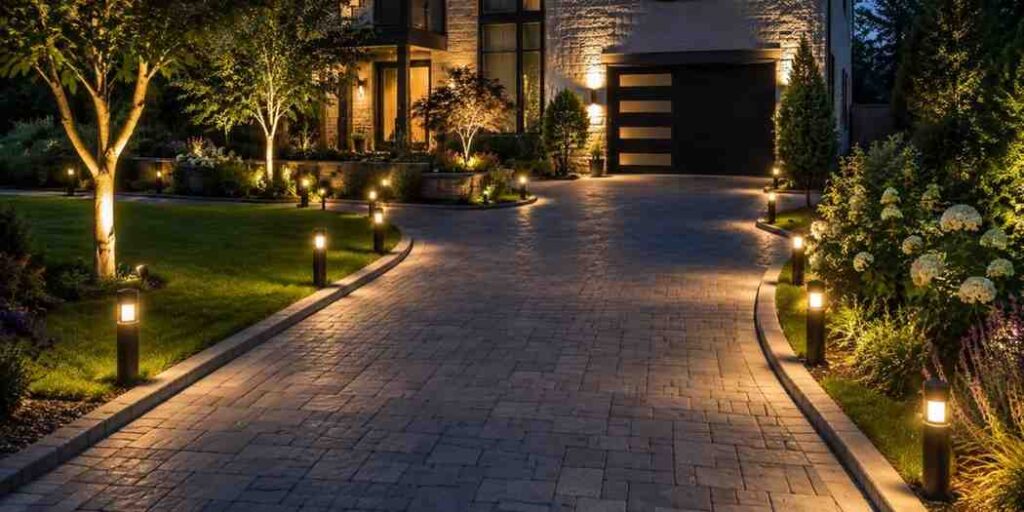
Bollard lights or recessed edge fixtures along a driveway define its boundaries at night without creating glare for arriving cars. This is as much a safety upgrade as an aesthetic one, especially for longer or curved driveways where the edges aren’t otherwise obvious after dark.
12. Create an Inviting Entry With Layered Entrance Lighting
Your front entry deserves special attention, since it’s the first (and last) thing guests see. Combine overhead lighting for general security and visibility with accent lights on flanking pillars, planters, or landscape features the layered effect creates a welcoming glow rather than a single stark porch light.
13. Use Fire-Based Lighting for Warmth and Ambiance
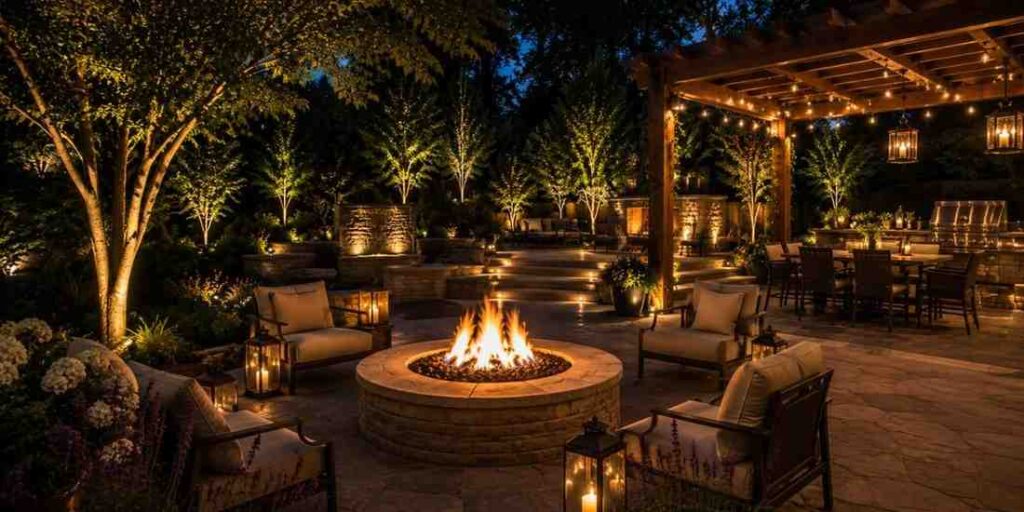
Beyond electric and solar fixtures, don’t overlook the ambiance of actual flame tiki torches, floating candles in a fountain or bowl, or a fire pit all bring a warm, flickering quality that electric lighting alone can’t replicate. For safety in colder months or windy conditions, flameless “fire without flame” LED alternatives can mimic the same glow without the risk.
How to Layer Your Garden Lighting Like a Pro
Professional landscape lighting designs almost always combine multiple light types rather than relying on one. Here’s how the layers typically break down:
- Ambient/general lighting: Broad, soft illumination think string lights or lantern clusters that sets the overall mood of the space.
- Task lighting: Functional light where you actually need to see clearly, like near a dining table, a grill, or front steps.
- Accent lighting: Focused spotlights or uplights that highlight specific features a tree, a fountain, an architectural detail.
- Path/safety lighting: Low, downward-facing fixtures that guide movement through the space after dark.
A garden that uses all four layers thoughtfully will feel far more polished and intentional than one relying on a single bright floodlight to do everything at once.
Choosing Between Solar, Low-Voltage, and Line-Voltage Lighting
Solar lighting is the easiest to install (no wiring required) and the most budget-friendly upfront, but it depends on consistent sun exposure and tends to produce softer, less powerful light best for accent and path lighting rather than major security needs.
Low-voltage lighting runs on a transformer that steps down household electricity, making it safer to install yourself than line-voltage systems while still providing more reliable, consistent brightness than solar. This is the sweet spot most homeowners land on for a full garden lighting plan.
Line-voltage lighting runs directly off standard household current and is typically used for security floodlights or larger-scale illumination needs. Because it involves working with full household voltage, installation is usually best left to a licensed electrician.
Common Garden Lighting Mistakes to Avoid
- Over-lighting the space. As with indoor design, a garden benefits from thoughtfully placed light, not maximum brightness everywhere. Too much light flattens the nighttime landscape and washes out the very features you’re trying to highlight.
- Placing path lights in a rigid, straight line. This creates an unflattering “runway” look. Stagger the spacing and placement for a more natural, garden-like feel.
- Ignoring your neighbors. Spotlights and floodlights should be angled carefully so they highlight your own landscape features rather than shining into a neighbor’s windows or yard.
- Using only one type of lighting. A garden lit entirely with string lights (or entirely with spotlights) misses the depth that comes from layering ambient, task, and accent sources together.
Frequently Asked Questions
What’s the easiest garden lighting to install myself?
Solar-powered fixtures are the simplest DIY option since they require no wiring. Low-voltage lighting kits are also relatively beginner-friendly and typically come with straightforward installation instructions.
How many lights does a garden actually need?
There’s no fixed number — it depends on the size of your space and how many features you want to highlight. A good approach is to start with essential path and entry lighting, then add accent lighting to two or three standout features rather than lighting everything at once.
Is landscape lighting expensive to run?
LED and solar fixtures are both energy-efficient options that keep running costs low. LED landscape lighting in particular uses a fraction of the energy of traditional bulbs while still providing bright, reliable illumination.
Can I mix solar and low-voltage lighting in the same yard?
Yes many gardens combine both, using solar lights for areas with good sun exposure and lower lighting needs (like path markers) and low-voltage wired lighting for spots that need more consistent brightness, like a dining or entertaining area.
Final Thoughts
A garden that looks beautiful in daylight but disappears into darkness at night is only living up to half its potential. With a thoughtful mix of string lights, uplighting, path fixtures, and accent spots layered the way a professional designer would, your outdoor space can become just as inviting after sunset as it is at noon. Start with safety and path lighting as your foundation, then build outward with ambiance and accent pieces until your garden has a genuine evening personality of its own.